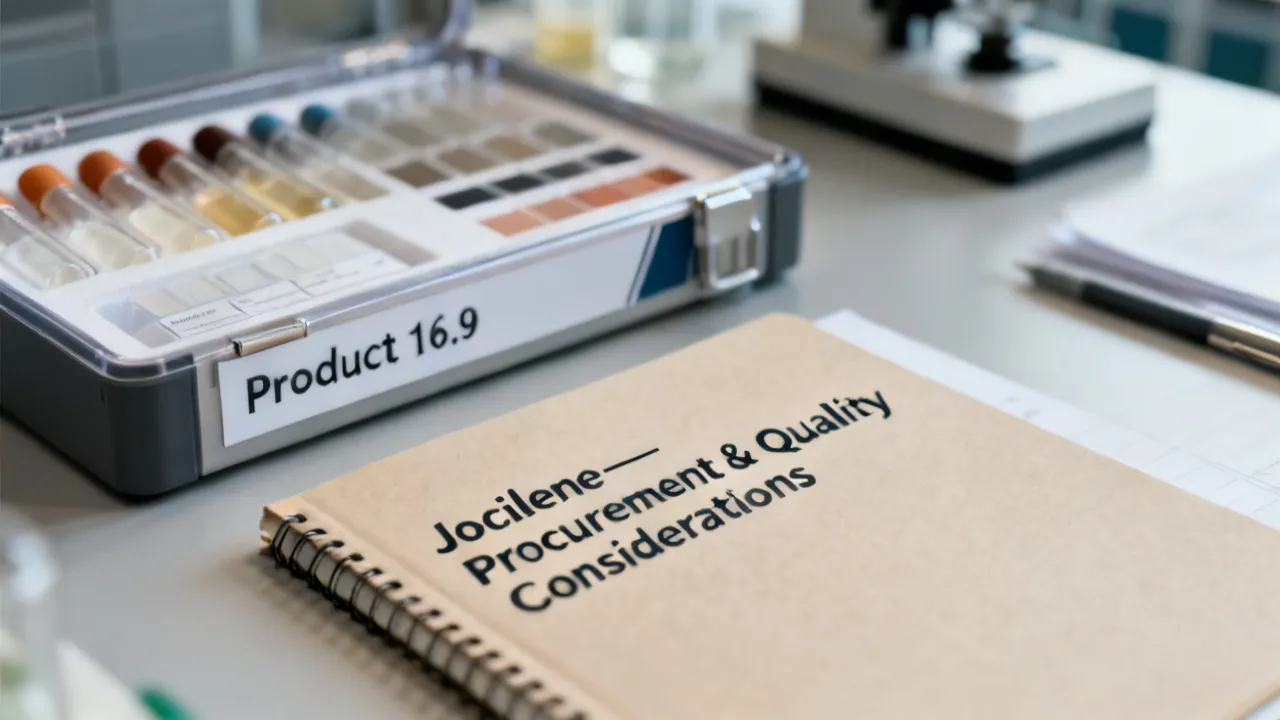
Jocilene: Supplier, Pricing, and Expert Considerations
This guide explains Jocilene procurement and supplier selection with a practical, expert lens. Background context covers what the term typically represents in supply discussions, why sourcing quality matters, and how buyers evaluate commercial offers objectively. You’ll also find a comparison framework, requirements checklist, and FAQ answers to reduce risk in purchasing decisions.

Executive Overview: How to Evaluate Jocilene Offers
When buyers search for Jocilene, the real challenge usually isn’t finding a listing—it’s distinguishing usable, compliant stock from offers that look similar on the surface. In many procurement settings, products that share a common sourcing term can still differ materially in formulation, grade, batch controls, packaging configuration, labeling practices, and intended use. This article focuses on an objective approach to pricing, supplier credibility, and quality documentation so you can make decisions you can defend internally. Instead of relying on marketing language, you’ll learn how professional buyers assess risk, traceability, and consistency across supply channels.
At a high level, the evaluation method can be summarized in four principles: (1) verify identity before quantity; (2) compare total cost on a like-for-like basis; (3) demand evidence tied to the specific shipment batch; and (4) design receiving/acceptance steps so you can detect nonconformance early. When you follow these principles, your team can move faster with less uncertainty—because the process reduces the likelihood of ordering the wrong variant or discovering missing documents after shipment.
Because the prompt did not include explicit numeric pricing data, this guide intentionally avoids inventing figures. Instead, it teaches you how to interpret the structures that commonly appear in procurement offers (unit price basis, MOQs, quantity breaks, freight inclusions, and document lead times). The goal is not to “find the cheapest quote,” but to determine which offer is likely to produce compliant inventory at the most predictable total cost, with the least downstream operational friction.
Why Jocilene Sourcing Demands More Than a Quick Quote
In most procurement environments, products categorized under terms like Jocilene can appear in multiple variants (for example, differences in formulation, packaging, batch labeling, shelf-life category, or intended use). Even when two offers reference the same keyword, buyers may be dealing with non-identical items. That’s why expert purchasing teams structure their evaluation around evidence: documentation, traceability, and whether the provided specifications match the intended application.
From an industry perspective, the most expensive mistake is not the sticker price—it’s an avoidable mismatch that causes rework, returns, regulatory or compliance complications, production downtime, or a cascading set of inventory and logistics problems. Replacing wrong or nonconforming goods can be far more costly than the difference between two quotes—especially when the supplier has to recreate paperwork, replace stock, or extend lead times. Therefore, the first decision point should be: Does the supplier clearly prove what you’re receiving?
Another common problem is that the supplier’s “product identity” can be described differently across documents. One supplier may describe Jocilene by a generic name in the commercial invoice, use a batch code format on the packing list, and provide a COA that references a slightly different internal nomenclature. None of these inconsistencies may be malicious, but inconsistency increases the probability of acceptance failures and complicates audit trails. A robust evaluation process accounts for these real-world document and labeling variations.
Finally, some buyers underestimate how much operational context matters. If your downstream process is sensitive to packaging format, mixing ratios, or storage conditions, then even a “technically similar” Jocilene variant could be unsuitable. Expert teams therefore treat the procurement decision as a matching problem: specification plus packaging plus storage plus documentation must all align with the way the product will actually be used.
What to Check First: Price Context, Not Just Price
Because the prompt did not include explicit numeric price data, this guide does not invent figures. Instead, it teaches you how to interpret pricing structures that commonly appear in procurement.
In practice, an offer can look inexpensive on a per-unit basis while being more expensive in total cost because of hidden factors. Your evaluation should therefore treat price as a model that must be normalized. Procurement teams often use “landed cost” thinking: the actual cost of possession and use includes the base product cost, logistics charges, handling/packaging fees, and any required inspection or compliance-related charges. Even when your organization does not formally calculate landed cost, you should mentally convert every quote into a comparable basis before making decisions.
- Unit price vs. total landed cost: confirm whether freight, handling, packaging, taxes, duties, insurance, warehousing surcharges, or any required inspection fees are included.
- MOQ and break quantities: lower unit prices can hide higher minimum order quantities or higher costs per order when you consider your actual ordering cadence.
- Batch-based pricing: some suppliers price by batch grade, shelf-life category, packaging configuration, or test-status category (e.g., “newly released batch” vs. “remaining shelf-life”).
- Lead time implications: urgent delivery often increases cost and may reduce options for careful QC. Conversely, longer lead times might allow for documentation review and inspection scheduling that reduces risk.
- Payment terms and cash-flow cost: longer payment terms can be economically valuable. If an offer requires prepayment or imposes strict payment milestones, factor the operational risk and cash-flow burden into the evaluation.
- Incoterms or delivery responsibilities: delivery terms can shift costs and control responsibilities between you and the supplier. Clarify who pays and who controls shipping, damage claims, and documentation handover.
For procurement teams, an offer is “good” only when it aligns with operational constraints—inventory planning, quality assurance workflow, and expected demand stability. If you cannot inspect quickly, stockout timing matters less than documentation completeness and batch traceability. If you require fast replenishment, then you must assess whether expedited shipping affects packaging integrity or whether the supplier’s QC release process can still meet your acceptance timeline.
Supplier Selection: Credibility Signals That Matter
When evaluating suppliers for Jocilene, expertise is less about who claims excellence and more about what they can verify. The strongest signals are usually operational and procedural:
- Documented traceability: batch/lot identifiers, manufacturing references, consistent labeling practices across shipments, and the ability to connect the lot code on the package to the COA and manufacturing records.
- Quality documentation: documentation such as certificates of analysis (COA) or equivalent evidence—provided for the specific batch, not generic templates. If the COA appears to be the same document reused with minor formatting changes, request batch-specific re-issuance.
- Clear spec sheets: the supplier should provide the specification profile relevant to your use case. It’s important that the spec includes the parameters you care about, plus the test methods or at least the test method references.
- Transparent terms: warranties, return conditions, and responsibility for defects. “We guarantee quality” is not sufficient—buyers need mechanisms: timelines, evidence requirements, and clarity on whether replacement, refund, or credit is offered.
- Batch change control: ask how they handle updates to formulation, supplier sources, packaging changes, or labeling revisions. Even small packaging updates can break your internal receiving workflows if not disclosed.
- Responsive communication: the speed and clarity of responses often correlates with how smoothly orders and investigations will proceed. If they cannot answer basic questions about identity, traceability, or storage within a reasonable timeframe, it can become a serious risk during receiving or disputes.
- Evidence of process consistency: for repeat purchasing, suppliers who can show consistent release practices across time reduce the likelihood of batch-to-batch variability. Buyers don’t need glossy certificates; they need repeatable evidence.
It’s also helpful to evaluate supplier maturity along three operational dimensions: (1) documentation handling, (2) logistics discipline, and (3) quality governance. A supplier can have good product but weak logistics, causing delays or labeling issues. Another supplier can have good logistics but weak quality governance, causing inconsistent batch results. Your evaluation should account for the full chain.
Quality and Compliance: The Non-Negotiables
Expert buyers treat quality as a system, not a checkbox. If you plan to store and use Jocilene in production or regulated workflows, you generally need the following non-negotiables—plus whatever additional requirements apply to your industry (for example, GMP-style expectations, documentation retention, or audit readiness).
- Consistent batch-to-batch performance (supported by documented checks). Consistency should be demonstrated by batch-specific evidence, not only by broad claims.
- Proper storage guidance (temperature, humidity considerations, shelf-life and handling notes). Storage guidance should be consistent with the way you will store the material.
- Evidence that packaging preserves identity (tamper resistance, labeling integrity, packaging material integrity, and protection against contamination or moisture ingress—if relevant).
- Clear acceptance criteria for incoming inspection. Acceptance criteria must align with your QA standards and the intended use. If you don’t define acceptance criteria up front, you can end up accepting inconsistent product or rejecting correct product.
- Test method relevance and traceability (when applicable): if test methods are referenced, confirm they are appropriate for the parameters and interpretation approach you will use.
- Packaging and label content completeness: confirm that labels include enough information to support internal traceability (e.g., batch/lot number, description, storage conditions, manufacturing date or expiry date if provided, and any hazard information if applicable).
Even if your organization is not in a heavily regulated sector, these practices reduce waste and improve forecasting accuracy. A procurement decision that looks “cheap” can become costly when goods fail acceptance or when missing documents slow down internal approval cycles.
Industry Perspective: How Professional Procurement Teams Reduce Risk
Procurement and quality teams typically apply a structured method: they qualify suppliers first, then qualify each batch at receipt. This two-stage approach is especially relevant for products associated with terms like Jocilene, where buyers may encounter different grades, packaging styles, or intended-use categories.
In practice, an experienced team will not rely on one-time documentation alone. Instead, they build a repeatable workflow:
- Map the exact requirement: what specification, what packaging, what intended application, and what internal acceptance tests are required.
- Request evidence before committing to volume: ask for spec sheets and batch-specific documents prior to shipping whenever feasible.
- Verify incoming goods with an acceptance plan: perform checks that verify identity, labeling, and whether the material meets the acceptance criteria.
- Monitor performance after receipt and refine supplier scoring: track delivery accuracy, QC pass rate, documentation completeness, and dispute frequency.
This method helps teams avoid “false confidence.” Sometimes a supplier provides strong documentation for the first batch, then changes packaging or batch sourcing. With batch-level receiving inspection and traceability checks, the team catches issues early rather than after product has already entered production.
Additionally, professional teams often apply a risk tiering approach. If the Jocilene variant is safety-critical or is used in high-impact production steps, the team might require tighter acceptance thresholds or additional testing. If it is low-risk and used in non-critical applications, acceptance criteria might be simpler, but identity verification and document traceability still remain essential.
Operational Considerations Buyers Often Overlook
Operational details can determine whether a procurement outcome is successful. Buyers may focus on spec and price but overlook the operational frictions that create delays or wasted inventory. The following considerations frequently matter in real-world purchasing:
- Packaging compatibility: ensure the packaging format matches your downstream process. For example, certain filling lines require specific container geometry or label placement. If your operators or automated systems rely on particular label layouts, packaging mismatches can create bottlenecks.
- Storage and shelf-life planning: your ordering cadence should respect shelf-life realities. Even if a product arrives “within acceptable expiry,” the usable shelf-life remaining may determine whether it can be used before expiration. Ask suppliers what the shelf-life remaining is at dispatch, where applicable.
- Documentation lead time: COA/spec documents often arrive with shipment, but some documents might arrive later due to batching or release cycles. Plan review time so QC and purchasing approvals do not stall production.
- Return and dispute handling: confirm how the supplier handles nonconformance before you place larger orders. Key details include how quickly the supplier responds, whether replacement stock is shipped, whether you receive a prepaid return label, and what evidence the supplier requires to process the claim.
- Label readability and language requirements: confirm whether labels meet your internal requirements and any local language expectations. Poor readability can cause traceability gaps.
- Damage and claims process: shipping damages can occur regardless of supplier quality. A clear claims process reduces downtime and avoids prolonged disputes.
- Batch numbering conventions: suppliers may use different batch formats (e.g., alphanumeric codes vs. numeric codes). Ensure your receiving and recordkeeping systems can capture the information without rework.
- Changeover management: if the supplier anticipates a formulation or packaging change, ensure they provide an advance notice plan. Without a changeover plan, you might accidentally introduce mixed-era inventory into production.
Requirements and Conditions: Comparison Table (No Links)
The table below summarizes how buyers typically compare supplier offers for Jocilene. It is designed to be used during vendor evaluation calls and purchase order preparation. You can copy this table into internal procurement documents and use it as a checklist to prevent incomplete vendor responses.
| Evaluation Area | What to Request or Confirm | Why It Matters |
|---|---|---|
| Product Identity | Exact specification, grade/category, intended use notes, packaging description | Prevents receiving a similar-but-not-identical variant |
| Batch Traceability | Lot/batch number format, manufacturing references, labeling photos on request | Enables traceability during QC or disputes |
| Quality Evidence | COA or equivalent for the specific batch; test methods if available | Supports acceptance decisions with verifiable proof |
| Pricing Structure | Unit price basis, MOQ, quantity breaks, shipping/handling inclusion | Ensures you compare “apples to apples” |
| Lead Time | Order-to-ship timeline, delivery windows, contingency lead times | Improves planning and reduces stockout risk |
| Storage Guidance | Temperature/humidity requirements, shelf-life statements, handling notes | Reduces degradation and ensures usable stock |
| Acceptance Criteria | Planned inspection tests and threshold limits (aligned with your QA) | Clarifies what “pass” means before shipment arrives |
| Returns and Liability | Nonconformance process, evidence required, timelines, responsibility split | Minimizes downtime and dispute escalation |
Step-by-Step Guide to Buying Jocilene Responsibly
Below is a practical, step-by-step guide you can adapt to your internal procurement workflow. The intent is to help you build a repeatable process that reduces risk while maintaining efficiency. Each step includes both a “what to do” and a “what to watch for,” based on common procurement failure modes.
-
Define the requirement precisely.
- Confirm the intended use and any constraints (packaging, grade, compatibility needs).
- Write down your acceptance criteria in plain language. Make sure they reflect both what you will test and what you will accept based on supplier evidence.
- Document any internal naming conventions for the Jocilene variant so you can avoid mismatches caused by differing supplier terminology.
-
Request documentation before purchase.
- Ask for the most relevant specification and evidence for the batch (e.g., COA or equivalent).
- Request clarification if the supplier offers multiple variants under the same umbrella term. Ensure the quote references a specific variant, not a generic label.
- Ask how documentation is tied to the shipped batch. If COA and lot references are missing or delayed, identify the “document release timeline.”
-
Normalize the pricing comparison.
- Convert all quotes to landed cost where possible. If you cannot compute full landed cost, at minimum compare freight and handling inclusions so unit comparisons remain meaningful.
- Compare unit basis, MOQ, freight inclusion, and packaging differences.
- Assess economic tradeoffs: a slightly higher unit cost might reduce QC rejection risk if the supplier’s documentation is more consistent or their packaging better preserves identity.
- Check for hidden conditions like restocking fees, non-returnable quantities, or unclear responsibility for shipping damages.
-
Evaluate supplier capability.
- Assess responsiveness, document readiness, and consistency of labeling.
- If applicable, verify whether they have a track record serving similar industries. If you cannot obtain references, use a structured questionnaire to validate traceability and quality governance.
- Confirm whether they provide packaging and label photographs before first shipment and whether they can replicate the same configuration for subsequent batches.
-
Plan incoming quality control.
- Set clear acceptance tests aligned with your QA process.
- Agree on what evidence you will use when decisions are made: supplier COA, your own verification tests, or a combination of both.
- Define the “documentation check gate” and “material check gate.” For example, you might block receiving into inventory until batch identifiers and COA/lot references match.
-
Receive with traceability checks.
- Confirm batch/lot identifiers match shipping paperwork and documentation references.
- Check packaging condition and labeling integrity.
- Perform a quick mismatch scan: verify that the item name on the invoice matches the spec variant and that the label batch/lot matches the COA batch reference.
- Record any deviations immediately with photos or internal logs. Delays in documentation can weaken the claim process.
-
Document outcomes and update supplier scoring.
- Record performance indicators: delivery accuracy, documentation completeness, QC pass rate, and dispute outcomes.
- Use the results to decide whether to scale volume, adjust acceptance thresholds, or switch suppliers.
- If problems occur, run a structured root-cause analysis. Look at whether the issue is upstream (supplier release practices), in transit (packaging or labeling damage), or downstream (receiving inspection gaps).
Common Conditions and Requirements
Procurement policies vary, but many organizations apply similar conditions. Consider these baseline requirements when buying Jocilene:
- Documentation must correspond to the shipped batch. Generic PDFs are often insufficient for acceptance. You want document-to-lot linkage.
- Orders should match stated specifications. Any substitution should be documented and approved before use. If a supplier makes an “equivalent substitution,” require written justification and proof of equivalence aligned to your acceptance criteria.
- Storage instructions must be provided clearly. If storage conditions are ambiguous, request clarification. Make sure the guidance aligns with your storage infrastructure.
- Dispute resolution timelines should be agreed in advance. Confirm how long you have to report issues and how quickly the supplier must respond.
- Data handling and recordkeeping: keep certificates and inspection records for internal audit readiness. If your compliance policies require retention periods, ensure you capture all necessary documentation at the time of receipt.
- Packaging and labeling preservation requirements: specify whether tamper-evident features are expected or whether certain label information must remain visible throughout shipping.
- Change notification: include a requirement that material/specifications/packaging changes are communicated before shipment where possible, and definitely before you receive a batch that differs from your approved specification profile.
Deeper Dive: How to Validate “Product Identity” for Jocilene
One of the most common procurement failures for products under generic sourcing terms is the “identity gap.” Even if a supplier responds with a spec sheet and COA, the buyer may still receive an item that does not match the intended variant. To reduce identity risk, buyers should implement a multi-step identity validation workflow.
First, lock the identity definition internally. Before evaluating offers, define what “Jocilene” means for your organization. This includes which grade/category you need, any purity or performance parameters that must be met, and any constraints related to packaging or storage. If you have internal codes (for example, a material master record), map that record to the supplier’s nomenclature. This mapping step prevents confusion and enables consistent receiving.
Second, require the supplier to state identity in multiple ways. Many suppliers can state the product name in a commercial email, but you should request identity confirmation in at least three formats:
- In the commercial quote or purchase offer, including the specific variant and packaging configuration.
- In the packing list and shipping documents, including lot/batch identifiers.
- In the COA (or equivalent), including the test item references and batch/lot linkage.
When these three align, the identity risk declines significantly.
Third, check for internal consistency in the batch documents. Buyers can reduce risk by reviewing whether the lot numbers and references match across documents. If the lot number on the label differs from the COA batch number (even by formatting), this might be a documentation error—or it might reflect different sourcing. Either way, it must be resolved before acceptance into inventory.
Fourth, ensure packaging does not erase identity. Packaging influences identity preservation. If labels can be removed easily, if the batch code is on a removable sticker, or if the shipping arrangement risks label damage, identity could be lost during transit. For high-traceability workflows, buyers often require tamper-evident packaging or at least label durability confirmation.
Fifth, validate storage guidance against your receiving and warehousing reality. If the supplier indicates storage conditions that are impractical for your warehouse, the product might be degraded before use. Even if identity and spec are correct, mismatched storage can still create failure at the “usable stock” stage.
Deeper Dive: How to Compare Pricing Without Losing Control of Total Cost
Pricing comparison for Jocilene offers can be deceptively complex because variations in packaging, shelf-life, and batch release status can affect actual cost. A unit-price-only approach can cause procurement teams to unintentionally compare different “value propositions.” Below are practical ways buyers normalize pricing while remaining objective.
Step 1: Standardize the unit of measure. Make sure quotes use the same basis: per kilogram, per liter, per container, per case, per drum, or per pallet. If a supplier quotes by container count while another quotes by weight, convert all values to a single consistent unit using the declared container net weight.
Step 2: Factor in packaging configuration differences. If one supplier offers bulk packaging and another offers smaller containers, the operational cost of handling and storage may differ. Also consider whether your internal process expects a certain container format. Even if you can store both, your inspection time and handling processes might differ.
Step 3: Normalize freight and delivery responsibilities. If shipping terms differ, unit prices cannot be compared directly. For example, if one quote includes delivery to your location while another excludes it, the apparent difference might evaporate after normalization. Document the shipping term clearly and confirm who is responsible for shipping insurance and damage claims.
Step 4: Evaluate MOQs and ordering cadence. A quote with a low unit price may require a larger MOQ than you can use before expiry. In that case, your operational risk increases: you might purchase more inventory than needed, tying up capital and potentially creating obsolescence. Buyers should evaluate quotes against expected consumption rates and shelf-life constraints.
Step 5: Assess document-related cost and timeline. Some offers include faster documentation release, while others require document requests post-shipment. Even though these differences might not show up as line-item cost, they create operational cost in QC scheduling and approval cycle times. Buyers can quantify this as “time-to-release” risk rather than monetary cost, but it still affects total procurement effectiveness.
Step 6: Include acceptance and rejection risk in procurement economics. Two suppliers might offer similar prices but differ in documentation completeness and batch consistency. A supplier with a higher “acceptance probability” can be economically advantageous even if their unit price is slightly higher. Procurement teams often incorporate this thinking into supplier scoring rather than purely numeric pricing.
Deeper Dive: Building a Supplier Credibility Score for Jocilene Offers
While many teams start with supplier reputation, strong evaluations rely on measurable signals. You can construct a supplier credibility score even without industry certifications by focusing on operational evidence and responsiveness.
Documentation Quality Subscore
- Does the supplier provide batch-specific COAs or equivalent evidence?
- Do they provide spec sheets that match your intended use parameters?
- Is there consistent lot/batch linkage across shipping docs and quality evidence?
- Are there clear revision histories for documents when changes occur?
Traceability Subscore
- Can the supplier explain their batch numbering and how it ties to manufacturing records?
- Do they provide label details that support traceability upon receipt?
- Do they respond quickly to traceability inquiries when discrepancies occur?
Operational Performance Subscore
- On-time delivery performance (even for early trial orders).
- Shipping documentation accuracy.
- Packaging integrity and label durability.
- Responsiveness and clarity in communication during order lifecycle.
Commercial Reliability Subscore
- Transparency of terms (returns, warranty, liability, claim process).
- Agreement on acceptance and dispute resolution timelines.
- Consistency of contract terms across shipments.
This scoring approach helps ensure your procurement decision is not purely based on a single quote but on a structured evaluation of risk. It also creates an internal rationale that procurement and quality leadership can align around.
Incoming Inspection and Acceptance: Designing a Practical Plan
Quality assurance is where risk becomes measurable. Even if you trust the supplier, the goal of receiving inspection is to confirm that the specific shipment meets your acceptance criteria. Buyers frequently fail by skipping acceptance planning at the start of a new supplier relationship.
Start with “gates,” not with endless testing. A good acceptance plan uses staged checks:
- Gate 1: Documentation and identity match. Confirm batch/lot identifiers align across labels, packing lists, invoices, and COA documents.
- Gate 2: Packaging condition and label readability. Confirm tamper evidence (if applicable), label durability, and integrity of container seals.
- Gate 3: Quality evidence review. Review COA parameters and verify that the test methods or parameter definitions match what you require.
- Gate 4: Optional or required testing. Perform your internal tests where necessary, especially if regulatory requirements demand it or if you want independent verification.
Define clear pass/fail thresholds. Acceptance criteria should not be vague. If parameters are not defined, testers may interpret results differently, leading to disputes and inconsistent decisions. Buyers should align acceptance criteria with internal QA protocols.
Document decisions and deviations. If you accept a batch with deviations (for example, minor documentation formatting differences), document it clearly and decide whether to require corrective actions for future batches.
Plan for escalation. Define what happens if documents do not match, if packaging is damaged, or if quality evidence suggests nonconformance. Escalation routes should be known before shipment arrival.
Managing Batch Traceability in Real Life
Traceability is not only about having a batch number. It’s about being able to use that batch number to answer questions quickly. When nonconformance occurs, buyers need to determine:
- Which batch is affected?
- Which inventory locations contain that batch?
- Which production lots consumed that inventory (if applicable)?
- Which supplier documentation applies to the affected batch?
To enable fast traceability, receiving teams should record batch identifiers exactly as provided on labels and documents, and store the associated COA and documentation in a way that supports retrieval during audits. If your receiving team uses barcodes, verify that batch codes can be scanned and captured without manual retyping errors.
Suppliers can also affect traceability with packaging. For example, if batch information is printed on a removable sticker that can peel during shipping, traceability could be lost. A traceability-focused buyer might require label redundancy (e.g., batch code printed on the container body, not only on a sticker).
Handling Returns and Disputes Effectively
Returns and disputes are not usually triggered by first-class purchasing discipline; however, when they do occur, the process can quickly become costly and stressful. Therefore, buyers should confirm return and dispute handling details before placing larger orders.
Clarify what qualifies as a nonconformance. Nonconformance can include:
- Identity mismatch (wrong grade or variant).
- Batch documentation mismatch (COA does not match lot/label).
- Quality evidence indicates failure or missing test results.
- Packaging damage that compromises integrity or labeling.
- Storage or handling claims that are inconsistent with the supplier’s declared conditions.
Clarify timelines and evidence requirements. Ask the supplier:
- How quickly you must notify them of issues?
- What evidence you must provide (photos, test results, sample retention)?
- Whether they will provide replacement stock, credit, or refund.
- Who pays shipping for returns and how the return logistics are handled.
Clarify acceptance after discovery. If an issue is discovered after goods are used, the dispute becomes more complex. Buyers can reduce this risk by ensuring that receiving inspection gates delay “release to production” until identity and basic documentation checks pass.
FAQs: Jocilene Procurement and Supplier Questions
1) What exactly is Jocilene?
“Jocilene” is typically used as a product identifier or sourcing term in commercial contexts. However, the exact meaning can vary depending on the supplier’s categorization and the specific grade or variant. For safe purchasing, confirm the exact specification and intended use with the supplier before ordering.
2) How should I compare prices for Jocilene?
Compare based on landed cost and like-for-like requirements: unit basis, MOQs, packaging configuration, shipping/handling inclusion, and any inspection charges. If quotes differ in batch size, shelf-life category, or packaging format, normalize the comparison to the way you will store and use the product.
3) What documentation should I request from the supplier?
Request the specification sheet relevant to your use case and quality evidence tied to the specific shipment batch (commonly COA or equivalent). Also ask for batch/lot labeling details and storage guidance. If possible, request clear identification that ties batch numbers across shipping documents and COA.
4) How do I know whether a supplier is reliable?
Look for verifiable traceability practices, prompt and consistent documentation, clear terms for returns and nonconformance, and evidence that their shipped batch aligns with the stated specification. Reliability is proven through operational clarity, not slogans.
5) Do I need to perform incoming inspection for every delivery?
In many professional settings, yes—especially at the start of a new supplier relationship or whenever the supplier indicates a change in packaging, batch sourcing, or release process. Even when repeat orders are made, acceptance checks reduce the risk of batch variation or labeling errors.
6) What should be included in an acceptance plan?
An acceptance plan typically includes what tests you’ll perform (or what evidence you’ll review), pass/fail thresholds aligned with your QA standards, and what documentation supports each decision. Ensure the plan is agreed internally before shipment arrival and that the team knows what to do if documentation mismatches occur.
7) Can the supplier change the product or packaging?
Suppliers may sometimes update packaging or make sourcing adjustments. Any change that affects identity, specification, or traceability should be disclosed and approved before use. Always require confirmation that the shipped item matches your requirement, and ensure COA/documentation ties to the correct lot.
8) What steps help reduce purchase risk for Jocilene?
Start with precise requirements, request batch-specific documentation, normalize quotes to landed cost, qualify the supplier based on evidence, and execute incoming inspection using agreed acceptance criteria. The risk-reduction strategy is strongest when you connect identity verification to the release-to-use decision.
9) What should I do if the COA batch number doesn’t match the label?
Do not accept the batch into inventory for use until the discrepancy is resolved. Contact the supplier and request clarification that ties the label lot number to the correct COA. If the supplier cannot resolve the mismatch promptly, escalate internally and treat the shipment as nonconforming.
10) What if the supplier provides a COA but it appears generic or template-based?
Request a batch-specific COA for the specific lot number. Ask for evidence that the test results apply to the shipped batch. If the supplier cannot provide a corrected, batch-specific document, evaluate whether you can proceed based on your internal testing capability and risk tolerance.
11) How do I account for shelf-life remaining at receipt?
Ask the supplier what the shelf-life remaining is at dispatch and specify an acceptable shelf-life threshold at receipt (if relevant to your use case). Then plan your ordering cadence so the usable period aligns with your consumption schedule.
Reliability Notes: How This Guide Avoids Unverified Claims
This article does not provide numeric pricing or performance statistics because none were supplied in the prompt. It also avoids speculative claims about market size or growth. Instead, it provides a procurement evaluation framework based on typical risk controls: identity verification, traceability, documentation integrity, and acceptance planning.
If you want to tailor the framework more tightly, you can share (1) the price range you’re seeing, (2) the supplier types you’re considering, (3) your intended application and any internal specification parameters, and (4) what regulatory or audit constraints apply. With that information, an evaluation checklist can be adjusted so it matches your decision criteria while remaining objective.
Suggested Next Actions
- Prepare a one-page requirement brief for Jocilene (spec, packaging, intended use, acceptance criteria, and required documentation).
- Request batch-specific quality evidence and traceability details from shortlisted suppliers before issuing purchase orders at larger volumes.
- Normalize quotes into landed cost where possible and document differences in MOQ, packaging, shipping inclusion, and documentation timelines.
- Run a controlled initial order with strict receiving inspection, then scale volume based on documentation completeness and QC outcomes.
- Implement a supplier scoring approach that tracks acceptance pass rate, document match quality, delivery accuracy, and responsiveness during discrepancies.
If you provide your preferred region (for example, a country/state) and your intended application, I can adjust the conditions/requirements language to better match typical local procurement and quality workflows—while keeping the evaluation approach objective and evidence-based.
-
1

A Guide to Cost-Efficient Small Electric Cars for Seniors
-
2
Mastering Debt Consolidation: Boost Your Credit Score and Manage Interest Rates
-
3
Your Guide to Loans, Credit Checks, and Interest Rates
-
4
Affordable Independent Living: Finding the Right Senior Housing
-
5
Guide to Senior Living Apartments: Affordable and Comfortable Environments